How do I quit porn? A practical step-by-step plan
Published 13 October 2026 - last updated 13 October 2026
You quit porn by removing the path before the urge arrives: find the moments you give in, lock the doors on your phone with protection you cannot remove in a weak moment, fill the empty time with something real, and treat any slip as a lesson rather than the end. Willpower alone tires out; a plan keeps going.
If you are reading this, you have probably tried before and said "last time". Then, days or hours later, you went back. That is not because you are weak. It is because you were fighting with the wrong weapon: willpower alone.
Willpower is like a battery. It runs down at the end of the day, when you are tired, bored or lonely. And porn on a phone is two taps away. So the fight is always an empty battery against an open door. This plan flips that: instead of resisting the urge every time, you remove the path altogether.
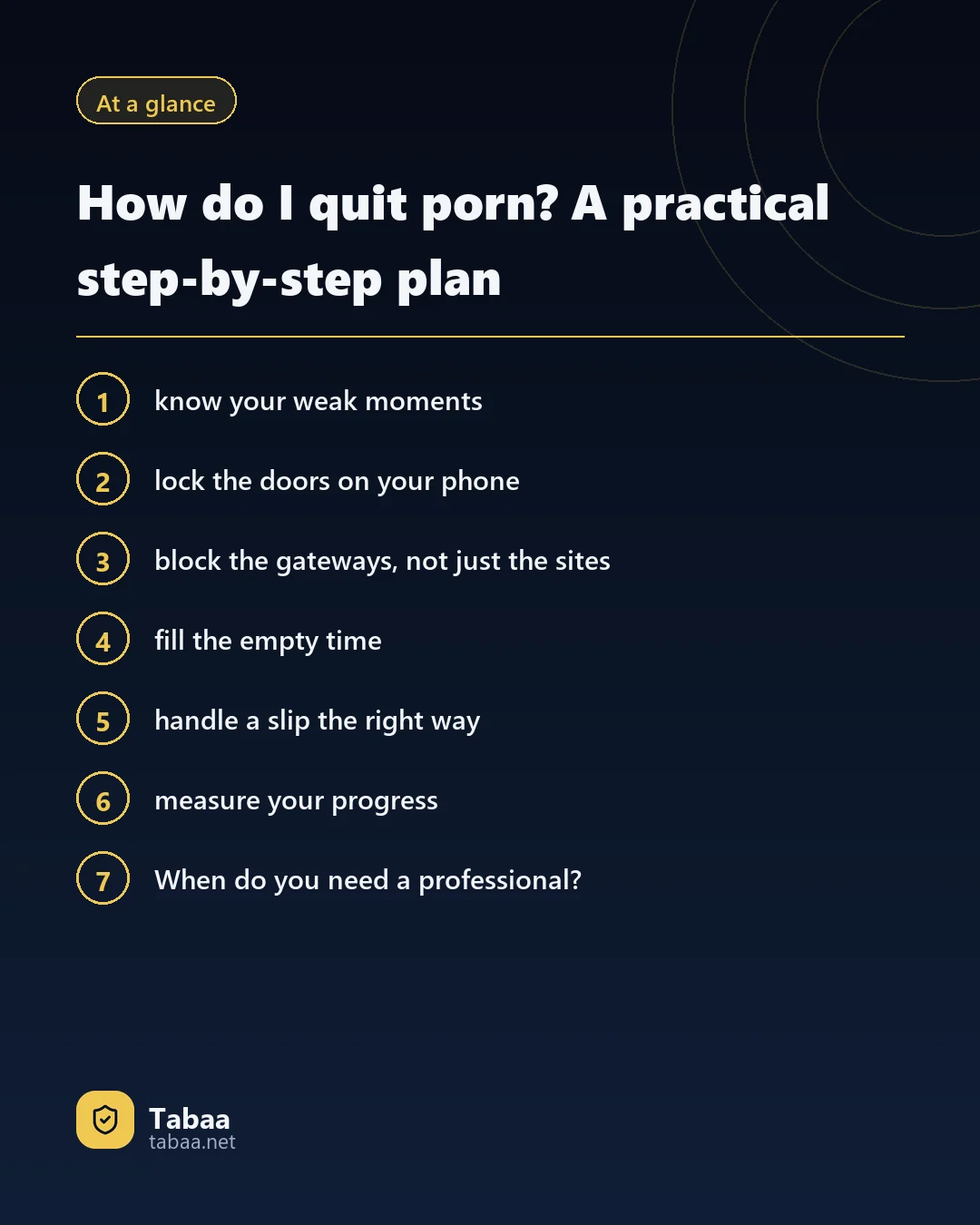
Step 1: know your weak moments
Going back to porn is rarely random. It usually happens in repeating moments. Write down the last few times and you will find a pattern:
- Time: late at night in bed? First thing in the morning?
- Place: alone in your room? In the bathroom with your phone?
- Feeling: bored? Stressed? Lonely? Upset after an argument?
- Starting point: an ordinary video on social media? An image in an app?
Once you know the pattern, you know where to stand. If you give in late at night, the phone sleeps outside your room. If it starts in a particular app, that app gets locked.
Step 2: lock the doors on your phone
This is the most important step, and most people get it wrong. They install an ordinary blocker and delete it on the first hard night. Or they change the DNS, or switch on a VPN, and everything is back as it was.
Protection that works has to be stronger than the weak moment: you cannot remove it in the middle of an urge. That is exactly what Tabaa Adults is built for:
- Porn is blocked from inside Android itself, on Wi-Fi and on mobile data.
- The app cannot be stopped or deleted from inside the phone.
- You can lock factory reset from Settings, and VPNs and DNS changes are locked.
- It keeps working after a reboot and with no internet.
No supervisor, and nobody needs to know. You make the decision once, with a clear head, and the system guards it for you.
Step 3: block the gateways, not just the sites
Many slips start with something that is not porn at all: a suggestive short video, an account on social media, a random video chat app. Those are the gateways. Block them yourself and make the block mandatory for a term, so you cannot take it back.
If you do not know where to start, the ready-made files page has reviewed lists of random video chat, live streaming and dating sites and apps that you import in a second.
Step 4: fill the empty time
When you remove a habit, it leaves a gap. Leave the gap empty and the old habit fills it again. Prepare ready alternatives for the risky moments:
- Movement: a fifteen-minute walk, push-ups, any sport.
- People: call a friend, or sit with your family instead of shutting yourself away.
- Achievement: something with your hands where you feel progress, like a skill or a project.
- Sleeping early: tiredness is willpower's worst enemy.
Step 5: handle a slip the right way
If you go back once, the road has not ended. The most dangerous thing after a slip is the feeling of "I have ruined everything", which turns one day into several. Instead:
- Do not punish yourself. Excess guilt sends you back faster.
- Ask: what happened just before? Which door was open?
- Close that door at once.
- Carry on from today, not from "the first of next month".
Step 6: measure your progress
What gets measured improves. The reports in Tabaa Adults show your screen time, app opens and blocked attempts day by day, for your eyes only. Watching the attempts fall week after week is the strongest reason to keep going.
When do you need a professional?
The World Health Organization lists "compulsive sexual behaviour disorder" in its International Classification of Diseases, ICD-11, under code 6C72, among the impulse control disorders. As the researchers who helped shape the diagnosis describe it, the key signs are that the behaviour becomes the centre of your life, you try to stop many times and cannot, and it continues despite harming you, for six months or more, causing marked distress or damage to your work, studies or relationships.
If that describes you, this plan helps, but talk to a psychiatrist or therapist as well. That is not weakness; it is the smartest decision you can make.
Start today, not tomorrow
Every plan is excellent on paper until the first hard night. The difference between those who keep going and those who go back is that the first locked the doors before they needed to resist. Your first step now: lock the door on your phone. See how on the page for adults, and the prices are on the pricing page.
Sources
Common questions
- How long until I quit for good?
- There is no single number. Many people feel a clear difference after a few weeks of commitment, and every day without watching makes the next one easier.
- If I slip, do I start from zero?
- No. A slip does not erase the days before it. Find out what happened just before, close the door you came in through, and carry on.
- Is blocking enough on its own?
- Blocking removes the ease, which is half the battle. The other half is understanding why you go back and filling your time with something else.
- When should I get professional help?
- If watching affects your work, studies or relationship, or you have tried many times and cannot stop, talk to a psychiatrist or therapist. That is not weakness; it is a smart decision.